
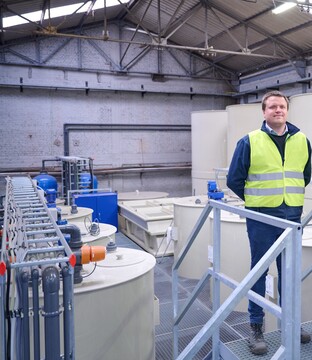
Piet De Schepper (Young VOM) wins Rising Star Award with innovative water treatment
Water is becoming an increasingly scarce and valuable resource in industrial production. This circular water treatment project demonstrates how water savings and sustainability can go hand in hand in an industrial environment. The completed installation represents an important step towards zero liquid discharge.
The objective of the project was to achieve Zero Liquid Discharge (ZLD), in line with the ESG goals of the Reynaers Group.
In a first phase, the existing wastewater was thoroughly analysed: composition, variations, flow rates, and different streams were mapped. Based on this, future flow forecasts were established with minimum and maximum scenarios to ensure process stability and operational continuity.
At the same time, strong emphasis was placed on energy efficiency, including the integration of photovoltaic solar panels to reduce electricity consumption.
Several technology providers submitted concept proposals. Ultimately, Eco-vision (Pollet Water Group) was selected due to their integrated process vision and robust technology.
The new wastewater treatment installation was implemented without interrupting production. It was fully constructed offline, next to the existing treatment plant. This posed a significant challenge for the Alural Belgium maintenance team, led by Didier Vanhove. Thanks to thorough preparation and close collaboration between all stakeholders, the final switchover was completed within a single weekend.
The installation evolved from a conventional system into a high-tech solution. The process begins with a two-stage physico-chemical treatment as pre-treatment of the wastewater, aimed at removing suspended solids and dissolved contaminants.
Subsequently, two vacuum evaporators installed in parallel ensure further concentration of the remaining water. This redundant setup increases operational reliability and allows discharge to be postponed as long as possible. If discharge becomes unavoidable, the effluent meets all applicable standards.
The produced distillate is fully reused as process water and as feed water for the demineralisation unit. Due to the high water quality, the regeneration frequency of ion exchangers is reduced, resulting in lower chemical consumption.
In collaboration with the technology partner, several optimisations have already been implemented to further improve process performance and energy efficiency.
Two years after commissioning, the installation is continuously monitored using performance indicators. Operational costs remain within the estimated budgets, confirming the reliability of the design. At the same time, ongoing data monitoring and process analysis support further optimisation to reduce energy consumption, chemical use, and maintenance requirements.
Since commissioning, the installation has achieved annual water savings of 60% and a reduction in discharge volume of 80% (and decreasing). For comparison, the original daily water consumption was close to the average annual water use of a standard household.
As a father of two young children, I am deeply aware of the importance of ensuring they grow up in a green and sustainable environment. Technologies such as circular water treatment with vacuum evaporation show that water savings and zero discharge are already achievable today.
Let’s do everything we can together to protect water and our environment — Together for better.
Since commissioning, the installation has achieved 60% water savings and an 80% reduction in discharge volume.
Author: Piet De Schepper – Alural Belgium NV