
Energy transition in Belgium: between progress and structural challenges
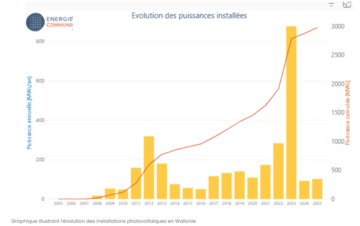
The development of renewable energy in Belgium is progressing, but remains marked by contrasting dynamics. While wind energy is confirming its recovery, photovoltaics has slowed down after an exceptional year in 2023. In a tense energy context, the question of energy sovereignty is more relevant than ever.
According to EDORA, which represents all stakeholders in the energy transition (wind, solar, hydropower, bioenergy, and green heat), the challenge is not to prioritize a single technology, but to build a balanced energy mix. This approach aims above all to ensure security of supply while accelerating the transition.
Real progress, but still insufficient
In Wallonia, the development of wind energy continues. In 2025, new installations increased the installed capacity, which now covers a significant share of electricity consumption. Despite this progress, the pace remains insufficient to meet the targets set for 2030.
In contrast, photovoltaics is slowing down. The end of the “reversing meter” mechanism has had a strong impact on new installations. This slowdown has reignited the debate on the actual trajectory of the energy transition in Belgium.
More broadly, the country is still lagging behind at the European level in terms of renewable energy. A major challenge lies in the heating sector, which still represents a significant share of energy consumption and whose decarbonisation is progressing too slowly.
Regional approaches are converging
Historically, Flanders and Wallonia have adopted different strategies: a more socio-economic approach in the north, and a more environmental one in the south. Today, these visions are gradually converging.
In recent years, Wallonia has shown strong momentum, particularly in wind energy, while Flanders remains more advanced in areas such as district heating networks. In solar energy, a rebalancing is expected, notably through the development of projects on rooftops, parking areas, and brownfield sites.
The challenge of permits and public acceptance
Despite significant potential, many projects remain blocked. The granting of permits is still a major obstacle, notably due to legal appeals and sometimes highly structured local opposition.
This situation highlights a key issue: the need to reconcile local interests with global objectives. The European Union has introduced the concept of “overriding public interest” for renewable energy, in order to facilitate its deployment.
Grids under pressure
The development of renewable energy is also facing a structural constraint: the capacity of the electricity grid. Long connection delays and high costs are slowing down the implementation of many projects.
Strengthening infrastructure is therefore essential, along with the development of flexibility solutions, storage, and smart demand management.
Heat: the blind spot of the transition
While renewable electricity is progressing, the transition in the heating sector is lagging behind. Heat pumps are identified as a key solution, but their deployment remains limited.
Several factors explain this: electricity prices, long higher than gas, and the condition of the building stock. However, a more pragmatic, case-by-case approach could accelerate their adoption.
Encouraging political signals
Finally, several recent developments suggest an acceleration in the coming years: improved permitting timelines, better regional coordination, and the announced introduction of new measures such as a tax shift in favor of electricity.
The year 2026 could mark a turning point—provided structural obstacles are addressed and a coherent long-term vision is maintained.
Source: Projecto, interview with Fawaz Al Bitar, Managing Director of EDORA